Monday, 8 January 2024

Victorian books with spines of 10mm


Victorian Books with spines of 10mm

@02012024; edited 18092023

Images: © The British Library Board; © The British Museum

Search of ca. 1500 records in my list of books for the text string “10mm”, yields some 30 citations/ books

Introduction

There have always been books bound with only a small amount of print within. Pamphlets, sermons, religious works (e. g. single books/ chapters from the Old/ New Testaments), auction catalogues – often these have been bound “bespoke”, and many have consequentially narrow spines. In the UK, in times before the rise and widespreqad use of cloth binding cases, the lettering was tooled on a leather spine. (Alternatively, paper labels with details of author and/ or title were pasted to the spine.)

As cloth and paper were used for book covers from the 1830s onwards, so cases were made before attachment to text blocks; and gilt letters and other decoration was applied to spines, most likely onto the cloth  by adapted arming presses. From a file of some 1,500 records, a string search of “10mm” yields just over thirty results. The results include a few books with paper over boards; there were probably many thousands of cheaper publications bound using paper of varying thickness, with printed decoration and lettering. The records and pictures below are listed by date of publication. This small sample shows that good, legible results of printing or of blocking were created for narrow spines. (Pictures are presented before the descriptive entry.)


[no image]

C.109.ff.24. Thomas Gray. Poems by Mr. T. Gray. Containing, I. Ode on the Spring, … VI. Elegy written in a Country Churchyard. Dublin: Printed for George and Alexander Ewing, at the Angel and Bible in Dame Street.  1756. 31p. With one page of publisher’s titles printed on the verso of page 31. 106x165x10mm.

References: Ecroyd Family:  https://www.houseofnames.com/ecroyd-family-crest

Notes: Pink endpapers and pastedowns. The turn-ins have a gilt repeating pattern of pairs of ‘flowers and small shrubs’. The upper pastedown has the bookplate of Geoffrey Ecroyd, a coat of arms with the motto: “In veritate victoria”.  The second bookplate is of Roger Senhouse. The upper endpaper has the ink stamp: “/ Bound by V. A. Brown, / Hildenborough, Kent Eng./” The size of the stamp is: 30x4mm. Full blue morocco. A single rule in gold is tooled on the outer and inner borders. On the corners of the inner border, floral ornament is in gold. The spine is tooled in gold; at the head and at the tail, there is small ornament. The words: “/ Poems by Mr. T. Gray. – Dublin, 1756/” are tooled in gold along the spine. Text copyright Edmund M B king.


11687.a.28. Charles Wheeler DENISON. The American Village; and other poems. Boston: Henry B. Skinner & Co., 39 Merchants Row. 1845. [Boston:] Howe’s Sheet Anchor Press, 39 Merchants Row. 143p. 1 Plate.105x165x10mm.

Notes: The blocking of the covers appears to have been done after the covers were attached to the text block. Cream endpapers and pastedowns. Binder’s blind oval stamp on upper endpaper: “/ B. Bradley [& Co.?]/ Binder/ Boston/”. Purple bead grain cloth. Both covers blocked identically in blind. Three rules to the borders. Leaf and stem patterns are blocked on each corner. On the centre, a pattern of lattice work is blocked within floral/ ornamental frame.  The spine is blocked in gold. Near the head, the words:”/ Denison’s / Poems/” are blocked in gold. Beneath this, an urn is blocked, full of flowers. More dense plant and stems are blocked down the spine, with a bird in flight and a rabbit being blocked within ‘spade-shaped’ panels. Text copyright Edmund M B King.


[no image]

11645.a.13. James Spilling. The Spirit of the Seasons, and other poems. London: Simpkin, Marshall and Co.; Ipswich: J. M. Burton and Co. 1850. Ipswich: Printed by J. M. Burton and Co.  xii,82p. 110x165x10mm.      

Notes: Gilt edges. Yellow endpapers and pastedowns. Pink coloured binder’s ticket on lower pastedown: “/ Bound/ by J. Brook/ Ipswich./” The ticket has been imperfectly trimmed at its head. Light green morocco vertical grain cloth. Both covers blocked with the same decoration in blind – rules to borders and plant ornament on each corner. The upper vignette shows a floral wreath, with the title words: “/ Spirit/ of the/ Seasons/” blocked in gold within it. Spine missing. Text copyright Edmund M B King.
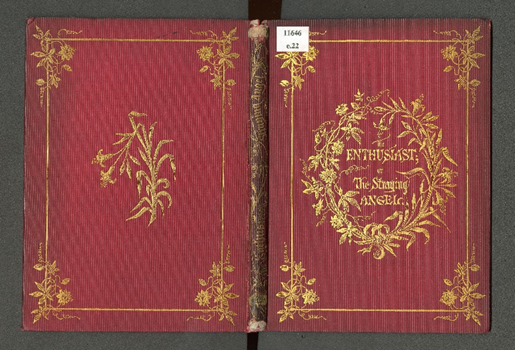


11646.e.22. James Orton. The Enthusiast: or, the Straying Angel. A poem. By James Orton. (“Alastor”) Author of “Excelsior”. London: William Pickering. 1852. London: C. Whitttingham, Tooks Court, Chancery Lane, 67p. 143x195x10mm.          

References: William Harry Rogers. Victorian Book Designer and Star of the Great Exhibition. Lewes: Unicorn, 2023. Appendix A. Gallery of Book Covers, no. 15. Copy bound in blue cloth.

Notes: Yellow end papers and pastedowns. Binder’s ticket on lower pastedown: “/ Bound by/ Bone & Son/ [rule]/ 76, Fleet street, / London./” [Ball no. 17A.] Binder’s ticket size: 20x10mm. Red rib vertical grain cloth. Both covers have a gilt single rule frame on the borders, with sprays of (passion?) flowers blocked in gold on each corner. The lower cover has a broken lily on its centre, in gold. The upper central vignette  has a wreath of stems leaves, and flowers, within which the title words: “/ The/ Enthusiast;/ or/ The Straying Angel./” are blocked in gold. Signed at the base of the vignette “WHR” as a monogram. The spine is blocked in gold. From tail to head a lily-like plant is blocked, with the title words: “/The enthusiast or the Straying Angel/ “ are blocked along its length. Pages 64 to 67 contain the ‘Opinions of the Press’ regarding Orton’s earlier work “Excelsior”, which is advertised as: ‘Just Published, Second Edition, small 4to, price 6s.’ Text copyright Edmund M B King.


BM P & D 1992,0406.50; BL1347.h.18. Campbell, Thomas. The pleasures of hope. Illustrated by Birket Foster, George Thomas, and Harrison Weir. London: Sampson, Low and Son, 47 Ludgate Hill, 1855. [London:] R. Clay, printer, Bread Street Hill.  [4], 59p. 137x204x10mm.The title page verso has the monogram of Joseph Cundall. The illustrations are drawn by Birket Foster, Harrison Weir, George Thomas. The illustrations are engraved by: Edmund Evans, Horace Harrild, William Measom, W. T. Green, James Cooper, Thomas Bolton, and J. Greenaway. The illustration on page one is drawn by Birket Foster, and is entitled: “At summer’s eve, when Heaven’s aerial bow”. Robin de Beaumont's notes regarding price and dating of this copy are written on the front endpaper recto. The bookplate of Robin de Beaumont is on the front pastedown, together with the bookplate of W. Clafton. Inscribed on the title page:  “/ Louisa Hammond Haigh, January/ 1856./”

Binding: Gilt edges. Bevelled boards. White endpapers and pastedowns. Bright green morocco vertical-grain cloth. Both covers are blocked identically in blind only on  the borders, and on the corners. Three fillets are blocked on the borders. A pattern of curling stems, of leaves are blocked on each corner, and inside this, more ‘branch-like’ fillets form the central panel, ending in small strap work on  the centre head and the centre tail – the whole forming an ornamental frame. On the upper cover the central vignette is blocked in gold. It has the title words: “/ The/ Pleasures of Hope [in a semi-circle]/ by/ Thomas Campbell./” are blocked in gold in Gothic letters. The capital letters have tendrils and strap work is blocked underneath these words. The spine is blocked in gold. Near the head, the title words: “/ The/ Pleasures/ of/ Hope/” are blocked in gold in Gothic lettering, with small straps in gold underneath the word “Hope”.


BM P&D 1992, 0406.362 BL: 1856: C.30.h.7. [not in BL database] Songs of the brave. The soldier’s dream, and other poems and odes by Campbell, Wolfe, Collins, Byron, Tennyson, and Mackay. Illustrated with twenty-six engravings, from drawings by Edward Duncan, Birket Foster [i.e. Myles Birket Foster], George Thomas [i.e. probably George Housman Thomas], etc. [Monogram of Joseph Cundall.] London: Sampson, Low, Son & Co., 47 Ludgate Hill, 1856. [London:] R. Clay, printers, Bread Street Hill. 46p. 142x202x10mm. With two pages of publisher’s titles bound at the end. In the [list of] Illustrations, the artist not listed on the title page is  A. Huttala. ‘The Head and Tail Pieces drawn by Thomas Macquoid. Engraved by Horace Harral, Edmund Evans, and James Cooper.’ The Illustration on page 38 is after A. Huttala, with the caption in the List of Illustrations: ‘Ring the joy-bells, light the blaze.’; and on page 38 the title is: ‘The joy-bell and the requiem’. The bookplate of Robin de Beaumont is on the front paste down.

Binding: The upper cover vignette is after William Harry Rogers. Gilt edges. Yellow endpapers and pastedowns. Blue wave diagonal-grain cloth. Both covers blocked identically in blind. Three fillets are blocked in blind on the borders. A pattern of intertwined stems and leaves is blocked on each corner, together with a laurel wreath on each corner. Stems and leaves are blocked on each side. [This is the same blocking as for RdeB.K.24.] The upper cover vignette is blocked in gold. It shows stems forming a circle, with small leaves and buds off the stems. The title: "/ The Soldier's Dream [in a semi-circle]/ and/ Other Poems./" is blocked in gold in gothic letters above and below the centre. On the centre, a hussar's helmet, a sword, and an anchor are all blocked in gold. Signed "WHR" in gold as a monogram at the base of the vignette. The spine is blocked in gold. The title: "/ The/ Soldier's/ Dream./ &c./" is blocked in gold in gothic letters, with branch, stem, and leaf decoration blocked between, above and below the letters.


1992,0406.65; BL 11633.c.14. Coleridge, Samuel Taylor. The rime of the ancient mariner. Illustrated. [the monogram of Joseph Cundall is printed on the title page verso.] London: Sampson, Low, Son & Co. 47, Ludgate Hill, 1857. London: R. Clay, printer, Bread Street Hill. The list of illustrations on pp. iii-iv states that these were drawn by E. H. Wehnert [i. e. Edward Henry Wehnert]; Birket Foster; E. Duncan [ i.e. Edward Duncan]. They were “engraved by Horace Harral and Edmund Evans.” Robin de Beaumont's notes regarding price and dating of this copy are written on the front endpaper verso. The bookplate of Robin de Beaumont is on the front pastedown. 140x202x10mm.

Binding: Gilt edges. Bevelled boards. Endpapers and pastedowns decorated with a leaf pattern. Both covers are blocked identically in blind on the borders and on the corners. Two fillets are blocked on the borders. Insider this, a pattern of seaweed stems of seaweed leaves, and a single shell on each corner is blocked – all forming an ornamental frame. The upper cover central decoration is blocked in gold. We see a ‘rising sun’ shedding its rays above seawater, which has vertical strands of sea plants reaching downwards. There are two eels blocked in gold amongst this vertical weed. At the base an albatross, with its neck twisted on itself into a knot, lies limply. The title words are blocked in gold amongst all this decoration, in Goth lettering: “/ The Rime of/ the/ Ancient Mariner/” The spine is blocked in gold. The title words: “/ The/ Ancient/ Mariner/ Coleridge/” are blocked in gold in Gothic lettering, surrounded by similar seaweed decoration as for the upper cover.


BM P&D 1992,0406.396; BL: 1266.e.26. Warton, Thomas. The Hamlet.  An ode written in Whichwood Forest. Illustrated with fourteen etchings by Birket Foster [i.e. Myles Birket Foster]. London: Sampson Low, Son, and Co. 1859. 14p. 142x205x10mm.  Text printed only on each recto. Robin de Beaumont’s notes regarding the price of this copy are on the front endpaper recto. The bookplate of Robin de Beaumont is on the front paste down. The illustration on page 1 is after Foster.

Binding: Gutta-percha binding. The upper cover vignette is designed by William Harry Rogers. Grey endpapers and pastedowns. Green sand-grain cloth. Rules and small corner decoration are blocked in blind on both covers. The upper cover central vignette is a diamond-shape, and the words: “/ The Hamlet/ an ode/ By Thomas Warton/ Illustrated with Etchings/ by / Birket Foster/” are blocked in gold, in ‘mediaeval’ style letters, surrounded by small foliage – also blocked in gold. Signed “WHR” [i.e. William Harry Rogers] in gold as a monogram at the base of the vignette. The spine is not blocked.

11647.de.16. John Benjamin Kerridge. Eden, and other poems. Weymouth: Printed and published by J. A. Buck, St. Thomas Street. 1861. viii, 120p. 118x168x12mm. Ticket size: 15x10mm.           

References: A citation of his name in: https://www.opcdorset.org/WeymouthMelcombeFiles/1851MelcombeRegisD3d.htm

Notes: Cream endpapers and pastedowns. Pink dyed binder’s ticket on lower pastedown: “/ J. A. Buck/ Printer/ Binder &c/” Purple morocco horizontal grain cloth. The lower cover is blocked with the same design as for the upper cover. On the upper cover, blocked in gold, there are rules on the borders with a repeating floral  pattern, and then repeating cartouches inside these. On the centre, the title: “/ Eden/ and other/ poems./” is blocked in gold. The spine is blocked in gold. From the base upwards, a lily-like plant is blocked. Near the head, the title: “/Eden/ and other/ poems/” is blocked in gold. More small floral decoration at the head. Text copyright Edmund M B King.


BM 1992, 0406.373; BL: 1347.i.18. Tennyson, Alfred. The May Queen. Illustrated by E. V. B. [i.e. Eleanor Vere Boyle]. London: Sampson, Low, Son, & Co., 47, Ludgate Hull, 1861.London: R. Clay, printer, Bread Street Hill. 40p. 161x215x10mm. The illustration on page 16 is after Boyle, with verse printed above and below it. Robin de Beaumont’s notes regarding the price of this copy are on the front endpaper verso. The bookplate of Robin de Beaumont is on the front paste down. Inscribed on the front endpaper recto: “/ [To] Sarah Angelina Acland/ from a kind Lady that had a good/ [not readable] while Mrs Sheffington/ Christmas Day 1861./” Bookplate on upper pastedown, with the inscription: “/ This/ Book/ belonged to/ S. A. Acland/ It is given in her memory to/ Betty/ by her brother/ Betty’s Great Uncle/ H W Acland/ 1931 Jany 26/” 

For descriptive details of the binder’s ticket, see: Ball, Douglas. Victorian publishers’ bindings. London, Library Association, 1985, Appendix E, Nineteenth Century Edition Binders’ Signatures.

Binding: The binding is possibly by Albert Warren. Gilt edges. Bevelled boards. Yellow endpapers and pastedowns. Binder’s ticket on lower pastedown: “/ Bound by/ Bone & Son/ 76, Fleet St. London./” [Ball no. 17C.] Blue morocco vertical-grain cloth. Both covers are blocked identically in blind and in relief on the borders, corners and sides, with stems leaves and flowers curling round a frame. On the upper cover, within an arabesque formed by a single gold fillet, the words: “/ The/ May Queen/ by/ Alfred Tennyson/ Illustrated by E. V. B./” Are blocked in gold in rustic, ‘gothic’ letters. The spine is blocked in gold and in relief. Gold fillets and small gold decoration are blocked across the spine at the head and at the tail. Down the spine, flowers stems and leaves are blocked in gold. A scroll is held by these, and, within it, the title words: “The May Queen” are blocked in relief. Signed “AW” [i.e.  possibly Albert Henry Warren] in gold as separate letters near the tail.
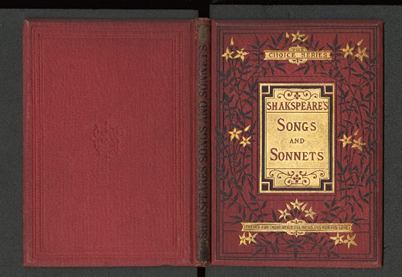

BL 11603.ccc.6. Shakspere’s Songs and Sonnets. Illustrated by John Gilbert. London: Sampson Low, Marstson, Low and Searle, Crown Buildings, 188, Fleet Street. [1863]. [London:] R. Clay, sons, and Taylor, Printers. 56p. 125x180x10mm.

References: For descriptive details of the binder’s ticket, see: Ball, Douglas. Victorian publishers’ bindings. London, Library Association, 1985, Appendix E, Nineteenth Century Edition Binders’ Signatures.


Notes: Beige endpapers and pastedowns. Binder’s ticket on lower pastedown: “/ Bound by/ Burn/ & Co./” [Ball no. 20E] Red rib diagonal grain cloth. The lower cover is blocked in blind with rule frames on the borders, and the publisher’s device blocked on the centre. The upper cover is blocked in gold and in black. Three black rules on the borders, with a with a profusion of stems, leaves in black, and flower petals in gold. In two cartouches near the head, the words:” The/ Choice Series/” are blocked in relief. The central rectangle is a gold lettering-piece, with a rule border in black, and with  the words: “/ Shakspeare’s/ Songs/ and/ Sonnets” picked out in relief. Below the centre, a rectangular gold cartouche has the words: “/ Theirs for their style I’ll read, his for his love./” The spine has the title blocked in black along its length. Text copyright Edmund M B King.


C.194.a.171. Wood, John George. Rowing and Sailing. By the author of “Athletic Sports and Recreations, “British Rural Sports,” etc., etc.  [i.e. J. G. Wood]. London: Routledge, Warne, and Routledge, Farringdon Street. 1863. London: Dalziel Brothers, Camden Press. [1], 92p. With four pages of publisher’s titles bound at the end.  95x143x10mm.

Notes: Inscribed on the upper endpaper recto: “/ Cherry Britton/ 27 Orient Gdns/ Belfast/” and inscribed on the upper pastedown: “/ Wm. Jackson Pigott/ Dublin/ 1864/” Pink/ beige endpapers and pastedowns. Printed yellow paper over boards. The lower cover  has a list of publisher’s titles. The upper cover shows a young man rowing, with a sailing boat in the background. At the head, the series title: “/ Routledge’s Sixpenny Handbooks’ is printed. At the tail, the imprint is: “London: Routledge, Warne, & Routledge./” Along the spine, the words: “/ Rowing  and Sailing – Sixpence./” are printed.


C.194.a.172. Routledge, Edmund. The handbook of cricket. London: Routledge, Warne, and Routledge, 6, Farringdon Street. 1862. London: Camden Press. 64p. 95x143x10mm.

Notes: Inscribed on the upper endpaper recto: “/ Wm. J. Pigott/ Mill Grove/” Inscribed on the upper pastedown: “/ Cherry Britton/ 27 Orient Gdns/ Belfast/”. Yellow endpaper and pastedowns at the front; original white pastedown at the rear. Printed yellow paper over boards. The lower cover  has printed advertisements of the publisher, including the series: ‘ Routledge’s Sixpenny Handbooks’. The upper cover shows a cricket field, with a pavilion tent in the background. In the foreground, a bowler hold his right arm, ball in hand, over a set of stumps (as though in the act of bowling). At the head and at the tail, the words: “/ Routledge’s sixpenny handbooks./ Cricket/ by/ Edmund Routledge/ Price sixpence/ London. Routledge, Warne, & Routledge./” are printed. Along the spine are printed the words: “/ Cricket. – Sixpence./”


BM P&D 1996,1104.21; [not in BL?] Hood, Thomas. The song of the shirt and other poems. New York: Bunce & Huntington, Publishers, 1865. 96p. 2 plates. 120x172x10mm.  The half title page has an illustration, which is signed with the monogram “WT” [i.e. probably Francis William Topham]. The plate between pages 24 and 25 is signed: “John Andrew”. Robin de Beaumont's notes regarding price and dating of this copy are written on the front endpaper recto. The bookplate of Robin de Beaumont is on the front pastedown.

Binding: Cream endpapers and pastedowns. Stamped on the front pastedown: “/ Hammann’s/ Book Bindery/ Easton, P.A./” Brown sand-grain cloth. A single fillet is blocked in blind on the borders of both covers. On the centre of the upper cover, the title: “/ Song/ of the shirt./” is blocked in gold. There is no blocking on the spine.

http://en.wikipedia.org/wiki/Francis_William_Topham

http://en.wikisource.org/wiki/Topham,_Francis_William_(DNB00)


BM P&D 1996,1104.47; BL 12804.b.52. 1858 A and C Black. Swift, Jonathan. A Voyage to Lilliput by Lemuel Gulliver. With a sketch of the life of Jonathan Swift. Edinburgh: Adam and Charles Black, 1865. Edinburgh: Ballantyne & Company, Printers. [1], vi, 122p. 110x165x10mm. The half title page features the legs of the giant, with horses, and their riders streaming out between them. The illustration is signed: “JM” as a monogram [possibly James Mahoney]. It is also signed: “MW Sc” [i.e. possibly John MacWhirter]. Robin de Beaumont's notes regarding price and dating of this copy are written on the front endpaper recto. The bookplate of Robin de Beaumont is on the front paste down.

Binding: Dark green endpapers and pastedowns. Brown bead-grain cloth. Both covers are blocked identically, in blind on the lower and in gold on the upper cover. Two fillets are blocked in blind on the borders of both covers , the outer thick, the inner thin. The words: “/ Gulliver’s/ Travels/” are blocked on the centre of the lower cover in blind and on the centre of the upper in gold. The spine has two gold fillets blocked across it a the head and at the tail. Near the head, the words: /” Gulliver’s/ Travels/” are blocked in gold, with a small five leaf motif blocked in gold beneath it.


BM P&D 1996, 1104.43. Ruskin, John. The King of the Golden River; or, the Black Brothers: A Legend of Stiria. Illustrated by Richard Doyle. Sixth edition. London: Smith, Elder, & Co., 65, Cornhill, 1867. London: Smith, Elder & Co., Little Green Arbour Court, Old Bailey, E.C. vi, 64p. 2 plates. 140x182x10mm. In the list of Illustrations on page vi, the engravers are: C. Thurston Thompson [i.e. Charles Thurston Thompson]; G. Dalziel [i.e. George Dalziel]; E. Dalziel [i.e. Edward Dalziel]; H. Orrin Smith [i.e. Harvey Edward Orrinsmith]; Isabel Thompson; C. S. Cheltnam [i.e. probably Charles Cheltnam].  Robin de Beaumont's notes regarding price and dating of this copy are written on the verso of page ii.  Inscribed on the upper endpaper recto: “/ Jessie Denton Hirst/ Jany 25th 1871-/”  Stamped on the upper endpaper recto: “/ Cinder/ St. George’s Hall/ Canterbury./” The bookplate of Robin de Beaumont is on the front paste down.

Binding: The text is sewn on two cords. Red speckled edges. Yellow endpapers and pastedowns. Orange wave diagonal-grain cloth. On both covers, two fillets are blocked in blind on the borders, the outer thick, the inner thin. On the centre of the upper cover, the figure of the King is blocked in gold above the title: “/The King/ of the/ Golden River/ or the/ Black Brothers/”, which is blocked in gold, in ‘branch like’ letters. On the spine, the title: “The King of the Golden River/” is blocked along its length.


BM P&D 1992, 0406.372; BL: 1867: 11648.g.16. This copy has original covers. Tennyson, Alfred. Enoch Arden, poema Tennysonianum Latine redditum [by William Selwyn]. Londini: Edv. Moxon ed Soc: A.D.1867. Canatabrigiae: typis academicis C. J. Clay, A. M. [8], 50p. 1 plate. The plate is bound in opposite page 1. It is not captioned. It shows the fishing village, within cliffs, the scene echoing the opening lines of the poem:

‘Long lines of cliff breaking have left a chasm;

And in the chasm are foam and yellow sands;

Beyond, red roofs about a narrow wharf

In cluster; then a moulder'd church; and higher

A long street climbs to one tall-tower'd mill;

And high in heaven behind it a gray down

With Danish barrows; and a hazelwood,

By autumn nutters haunted, flourishes

Green in a cuplike hollow of the down.’

Robin de Beaumont’s notes regarding the price of this copy are on the front endpaper verso. The bookplate of Robin de Beaumont is on the front paste down.

170x220x10mm.

ODNB: http://www.oxforddnb.com/view/article/25069?docPos=2

Wiki: https://en.wikisource.org/wiki/Selwyn,_William_(1806-1875)_(DNB00)

Inscribed on the half title page recto: ‘/ C J Stewart/ from W. Selwyn [i.e. William Selwyn, the translator of the text]/ 1867/ ‘

Binding: Gilt edges. Bevelled boards. Brown endpapers and pastedowns. Green pebble-grain cloth. The borders of both covers are blocked identically, in blind on the lower cover, and in gold on the upper cover. On the upper cover, multiple fillets form squares on each corner, and rectangles on the sides, the head and the tail. Fleur-de-lis and gold dots are blocked within each rectangle. Within each corner square, stylised flower heads are blocked in gold. On the centre, the title words: “/ Enochus  Arden/” are blocked in gold, ‘rope-like’ letters, on each side of an anchor, also blocked in gold. The spine is not blocked.


BM P&D 1992,0406.359; BL: 1870: 12807.ff.17. The silver bells. An Allegory. Illustrated by Arthur Hopkins. Oxford and London: James Parker and Company, 1870. [London:] Dalziel Brothers, engravers and printers, Camden Press. 50p. 157x208x10mm. With one page of publisher’s titles bound at the end. The frontispiece is after Hopkins, and is captioned: ‘/ “ever and anon he could hear, above the noise of the waterflood,/ the silvery tones of Alice’s little bell.”/’ Robin de Beaumont’s notes regarding the price of this copy are on the frontispiece recto. The bookplate of Robin de Beaumont is on the front paste down.

Inscribed on the frontispiece recto: “/ C. M. Limrich/ January 31st. 1889/”

For descriptive details of the binder’s ticket, see: Ball, Douglas. Victorian publishers’ bindings. London, Library Association, 1985, Appendix E, Nineteenth Century Edition Binders’ Signatures.

Binding: Bevelled boards. Brown endpapers and pastedowns (upper endpaper is missing). Binder’s ticket on lower pastedown: “/ Bound by/ Burn/ & Co./” [Ball no. 20D.] Blue ungrained cloth.  Two fillets are blocked in blind on the borders of both covers. On the upper cover, the central rectangle is formed by groups of three gold fillets, which end in ‘three leaves’ motifs. Within the rectangle, the title words: “/ The/ silver/ bells/” are blocked in gold. Suspended above the word ‘silver’ by two ropes, two bells, blocked in ‘silver’, ring out. The spine is not blocked.


BM 1992,0406.43; BL: 1864: General Reference Collection D-1754.b.7. BL does not appear to have the second edition of 1875. Bunyan, John. Illustrations to Bunyan’s Pilgrim’s Progress by Fredk Shields. Second Edition. London: Simpkin Marshall & Co.; Manchester: A. Ireland & Co., 1875. Unpaginated [20 pages of letterpress, printed on recto only; 19 plates.] 251x318x10mm  The frontispiece portrait of John Bunyan is after Frederick Shields, and also signed: “Orrinsmith” [i.e. Harvey Edward Orrin Smith]. Plate seven is of the Apollyon and Christian. Robin de Beaumont’s notes regarding the price of this copy are on the front endpaper recto. The bookplate of Robin de Beaumont is on the front paste down. The title page is inscribed: “/ To Mrs Charles Kingsley/ in grateful memorial/ Fredk. J. Shields/”

Binding: Yellow endpapers and pastedowns. Brown sand-grain cloth. On the boders of both covers two fillets blocked in blind make the border frame. On the upper cover, within a rectangle formed by a single gold fillet, the words: “/ Illustrations/ of/ Bunyan’s Pilgrim’s Progress/ by Fred. J. Shields./2 are blocked in gold. The spine is not blocked.


BM P&D 1996,1104.28. BL:1881. 7854.bbb.21. [1882] 7868.aa.6. Marx, George Walter. The Art of Drawing and Engraving on Wood. Illustrated. [London:] Published by Houlston & Sons, Paternoster Square, E. C. and Marz & Co., 211, Strand, W. C. [1880]. 52p. 122x183x10mm. The frontispiece is signed and captioned: “Sunset./ (Drawn by Birket Foster.)/ [i.e. Myles Birket Foster]” A  colour print is pasted onto the upper pastedown, with the handwritten caption: “/ Baxter print/ by his successor:/ Le Blond & Co./ (Licencees)/” [i.e. Abraham Le Blond]. Robin de Beaumont's notes regarding price and dating of this copy are written on the frontispiece recto. The bookplate of Robin de Beaumont is on the front paste down. Inscribed on the title page recto: “/ M. A. Brocklehurst/ Stockport ‘81/”

http://en.wikipedia.org/wiki/George_Baxter_(printer)

Binding: White pastedowns. Green pebble-grain cloth. There is no blocking on covers or spine. The spine has a label pasted onto its upper half, with the words: “Wood engraving written on the label along its length.


C.109.ff.21. Artist Name: Laurence Housman. Robinson, Charles Newton. The Viol of Love. Poems.London: John Lane, Bodley Head; Boston: Lamson Wollfe and Co.1895.  [Edinburgh:] Printed by T. and A. Constable at the Edinburgh University Press. viii, 56p.130x197x10mm.              

References: Haslam, Malcolm. Arts and Crafts Book Covers. Shepton Beauchamp, Richard Dennis, 2012, no. 23.

Notes: Page 2 states: “ Of this edition only 350 copies have been printed”. The colophon states: “ The cover, Title-page, and other ornamental designs are by Laurence Housman.” Cream endpapers and pastedowns. Green ungrained cloth. The lower cover is not blocked. The upper cove is blocked in gold. It has an all over design of interlinked curling stems and ‘bunches of flowers’ which appear to be hanging upright. The stems are hooked onto the border ‘branches’, which are formed by two gold fillets blocked on the borders. In the right hand upper corner of the cover, the words: “/ The Viol/ of Love/ and other poems/ by Charles/ Robinson/” are blocked in gold. The spine is blocked in gold. At the head and at the tail, the words: “/ The/ Viol/ of/ Love/ The/ Bodley/ Head/ &/ Boston/” are blocked in gold. Four ‘water drop’ shapes are blocked in gold down the spine.


W7/1241. Artist Name: Laurence Housman. Rossetti, Christina. Goblin Market. Illustrated by Laurence Housman. London: Macmillan & Co.1893. [Edinburgh: R & R Clark.]  [3], 63p. 106x186x10mm.   

References: Haslam, Malcolm. Arts and Crafts Book Covers. Shepton Beauchamp, Richard Dennis, 2012, no. 20.

Notes: The design is by Laurence Housman. The device of R & R Clark, printers, is on the verso of page 63. Gilt edges. White/ cream endpapers and pastedowns. Green ungrained cloth. Both covers are blocked with an identical design. A single  gold fillet is blocked on the borders. The design blocked in gold on the covers is of interlocking curling stems, and of flower buds. On the top left of the upper cover/ the title words: “/ Gob-/lin/ Mar/ ket/” are blocked in gold, within a rectangle formed by a single gold fillet. This is repeated on the lower cover, top right. Six ‘clasps’ are blocked ion the spine side of each cover, with gold ‘bands’ blocked across the spine to join them – an imitation of open spine stitching of earlier times. The lower cover is signed  in the right hand corner: “LH” [i.e. Laurence Housman] as a monogram. Another copy of this work is at BL shelf mark 11647.f.33. It is a large paper edition of the work, printed in one hundred and sixty copies in December 1893. This copy has a plain green ungrained cloth binding, with no blocking.


2346.a.3. Artist Name: William Snelling Hadaway. Guingamor Lanval Tyolet Le Bisclaveret [The Werewolf]. Four lais rendered into English prose from the French of Marie De France and others by Jessie L. [i.e. Laidlay] Weston. With designs by Caroline Watts. London: Published by David Nutt at the sign of the Phoenix, Long Acre.1900. London & Edinburgh: Printed by Ballantyne, Hanson & Co. xv, 101p. 112x145x10mm.                  

References: Haslam, Malcolm. Arts and Crafts Book Covers. Shepton Beauchamp, Richard Dennis, 2012, no. 17.

Notes: The design is by William Snelling Hadaway. Arthurian Romances no. III. White endpapers and pastedowns. Originally orange (?) ungrained cloth. The lower cover is not blocked. The upper half of the upper cover is blocked in gold and in green, with a black fillet on its borders. It shows a scene of a knight, mounted on a horse, with a hunting dog running in front of him, and with a fruit tree, a sloping hill and a church and its tower blocked in the background. The dress of the knight is blocked in gold with its decoration picked out in relief. Signed “H” [i.e. William Snelling Hadaway] in the bottom right hand corner of the cover. The spine is blocked in black with the title words: “/ Four/ Lais/ of/ Mar-/ ie/ de/ Fra/ nce/”. There are identical designs, apart from the titles, on Arthurian Romances, no. I – Sir Gawain and the Green Knight; no. II – Tristan and Iseult (2 vols.). Formerly shelved to be available to readers in the Round reading room of the British Museum.
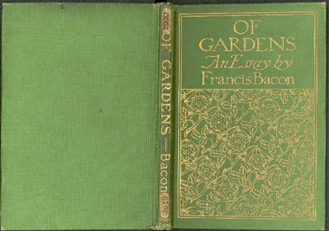

7030.de.13. Artist Name: Edmund Hort New. Bacon, Francis. Of Gardens. An Essay. With an Introduction by Helen Milman and Frontispiece and Cover Design by Edmund H. [i.e. Horton] New. London & New York: John Lane.1902. Boston (Mass.): D. B. Updike, the Merrymount Press. 29p. With eight pages of publisher’s titles bound at the end. 106x152x10mm.

References: Haslam, Malcolm. Arts and Crafts Book Covers. Shepton Beauchamp, Richard Dennis, 2012, no. 47.

Notes: The design is by Edmund Horton New. On page two of the publisher’s titles at the end, this work is advertised as: “Demy 16mo. 2s. 6d. net.” Cream endpapers and pastedowns. Green rib vertical-grain cloth. The lower cover is not blocked. The upper cover is blocked in gold. Two gold fillets are blocked on the borders. The upper third of the cover has the title words: “/ Of/ Gardens/ An Essay by/ Francis Bacon/” blocked in gold. The rest of the cover is occupied by a repeating pattern of ‘rose’ stems, leaves and flowers. Signed: “EHN” [i.e. Edmund Horton New] in gold on the right hand corner. The spine is blocked in gold. The words: “ Of Gardens –Bacon” are blocked along the spine. At the tail, the imprint: “/ John/ Lane/ is blocked in gold. Another copy of this work as at BL Shelf mark 823.3 *896*.


BM P&D 1992, 0406.347; BL 11603.aaa.18. Rowley, Charles. A treasury for the young of all ages. Selected by Charles Rowley. Manchester: Sherratt & Hughes,1903. Manchester: Printed by S. Clarke, 58 Sackville Street. 80p. 8 plates. 118x161x10mm. Robin de Beaumont's notes regarding price and dating of this copy are written on the front cover verso. Printed in the Acknowledgement on page 3: “The living artists to be thanked for pictures are Miss Emily Thomson and Mr. Frederick Shields.” The illustration on the verso of the plate between pages 28 and 29 is entitled: “/ What o’clock is it?/ From a drawing by F. Shields/”. It shows two girls and a boy seated in a field, with the boy blowing the seeds from a dandelion head.

Binding: Beige paper covers. The upper has the title printed at the head. On the centre is a vignette, showing five young adults dancing, with hands joined. The motto: Peace on earth/ Goodwill to all men/” is printed on the perimeter. The lower cover has verses by P. B. Shelley. Between the verses, there is an illustration of two nymphs seated in a “shell-like” boat. The spine is plain, without printing.


BM P & D 1992,0406.247; BL: 1904: 11656.c.10. Parnell, Thomas. The Hermit, a Poem. With Thirty Pictures designed and drawn in Pen and Ink by Edward Dalziel. London: Camden Press, N. W., 1904. Printed and Published by Dalziel and Co., Ltd., Camden Press, N. W.  46p. 265x200x10mm. The Illustration on page eleven is captioned: “The Hermit”.  Robin de Beaumont's notes regarding price and dating of this copy are written on the front endpaper recto. The bookplate of Robin de Beaumont is on the front paste down.

Binding: Thick card/ paper originally cream in colour. The lower cover and the spine have no printing. The upper cover has a rectangular panel and a roundel inside which is depicted the figure of Christ. The title words: “/ The Hermit/ A Poem/ by/ Thomas Parnell/ [inverted triangular decorated device[/ With 30 Illustrations by Edward Dalziel/” are printed on the lower half of the cover. Inscribed at the head of the upper cover: “/ To Herbert Dalziel/ With much affection from his Uncle Edward/ Dalziel/”.


W11/4286. Aucassin & Nicolette. Translated from the Old French by Eugene Mason. With coloured illustrations by Maxwell Armfield. London: J. M. Dent & Sons, Ltd.; New York: E. P. Dutton & Co. 1910. London and Bungay: Richard Clay & Sons, Limited. 72p. 6 plates. 132x183x10mm.   

References: Haslam, Malcolm. Arts and Crafts Book Covers. Shepton Beauchamp, Richard Dennis, 2012, no. 15.

Notes: The design is by Robert Percy Gossop. White endpapers and pastedowns. White ungrained cloth. The lower cover is not blocked. The upper cover is blocked in gold, in grey and in green. On the borders, a repeating pattern of stems and leaves, blocked in green, is interspersed with small flower heads, blocked in gold. This pattern is blocked between two gold fillets. The intern rectangle is formed by repeating dots and a single gold fillet. In the upper half of the rectangle, the title words: “/ Aucassin/ and/ Nicolette/” are blocked in gold in gothic lettering within rectangles formed by a single gold fillet. The lower half of the rectangle has alternating squares of flower heads and leaves, blocked in grey and in green and gold – and a knot motif, blocked on gold with a green diamond at its centre. are blocked in gold within rectangles formed by a single gold fillet. The lower half of the rectangle has alternating squares of flower heads and leaves, blocked in grey and in green and gold – and a knot motif, blocked on gold with a green diamond at its centre. The spine is blocked in gold and in green. Two fillets are blocked in gold down each side of the spine. At the head and at the tail, a small flower head and four small leaves are blocked in gold and in green, each within a square formed by a single gold fillet. Down the length of the spine, the title words: “/ Aucassin and Nicolette/” are blocked in gold in gothic lettering. Another copy of this work is at BL shelf mark X4/7785. It has its original covers.


BM P & D 1992,0406.351; BL: 1915: 7859.d.16.Sandys, Frederick. Reproductions of woodcuts by F. Sandys. London: Published for Mrs. Sandys, 5, Hogarth Road, Kensington by Carl Hentschel, Ltd., 182, 183, 184, Fleet Street, E. C. [1915]. [7p], 25 Plates; fifteen sheets, folded into a single quire, with the plates being printed on the recto of each half sheet. 200x260x10mm. [With a preface by Borough Johnson.] The Illustration on page eleven is captioned: ‘The death of King Warwulf’. Robin de Beaumont’s notes regarding price and dating of this copy are on a separate slip of paper. Signed on the title page: ‘Forrest Reid’ and ‘J. N. Hart’. Inserted loose as the front, is an article by Gleeson White: ‘A great English illustrator. (Frederick Sandys.)’  from the Pall Mall Magazine, together with  two more inserts.

Binding: Beige printed card, made to resemble ungrained linen. The text block is stab stitched in three places above the middle, with cords being tied on the spine. The single piece of card folds over the text block at spine and at fore edge, with the words: “/ Reproductions of/ Woodcuts by/ F. Sandys – 1860-1866./ Edited by Mary Sandys/” being printed on the cover.

Edmund M B King

St Albans

January 2024


Sunday, 24 December 2023

Two Centuries of UK Bookbinding. The evidence from newspapers


@23122023

TWO CENTURIES OF UK BOOKBINDING

The evidence from newspapers

 by Edmund M. B. King

 Note: All images are © British Library Board; and texts within images are © British Newspapers Archive. The text of this essay is © Edmund M. B. King.


 Bookbinding in the United Kingdom seems so well known, it is assumed to exist. To show this in a more concrete fashion, an exercise was carried out with the aim of finding advertisements/ notices or articles about bookbinders in newspapers.

 The ten-year existence of the British Newspapers Archive, 2011-2021, has resulted in fifty million scanned pages of newspapers, with publication dates from the early 1700s to the 1960s. (Seventy-three million pages as of December 2023.) Moreover, the scanned images have been run through optical character recognition software, so that searches may be carried out. This is a very large body of print history available for searching.

 Newspapers published in all areas of the UK, including Belfast and Dublin, were included in this study. One newspaper from each area/ county, and some published in major cities, were searched. Long runs of a newspaper were preferred, so that results for a long publication period could be looked at. Once a newspaper title was selected (e.g. The Carlisle Journal), a filter search term ‘books bound’ or ‘bookbinding’ was applied, across all dates of publication. For every newspaper, there were hundreds of citations. On occasion, a filter of a date range, e.g. 1700-1749, or 1800-1849, would be applied.


Trade advertisements, articles, auction notices, obituaries, and other stories of interest were selected, and a ‘cutting’ of the article was stored as an image. Normally, these were selected from the first page of results displayed. The list of newspapers consulted is at Appendix B. The results of the searches can be found in an Index of Bookbinders at Appendix A. No attempt was made to find all the citations for a bookbinder.


The citations grouped themselves into three broad categories:

     1. A trade advertisement for one bookbinder (individual or business)

     2. A trade advertisement, where bookbinding is just one of several trades being undertaken (bookselling, stationery, printing, etc.) - frequently, multiple repeat advertisements were paid for;

     3. Small articles, which feature a story - topics as diverse as accidents, robbery, circulating libraries, emigration, binder’s shops in newspaper offices, auctions of a binder’s tools/ equipment, obituaries, treatment of leather, gift bindings. These articles/ subjects are included in the Index of Bookbinders.


Advertisements

Many bookbinders advertised themselves solely as engaged in the Bookbinding trade. Examples are:

a)    CHAMBERLAIN’S Bookbinding! (Exeter and Plymouth Gazette 27 June 1916 page 4);

b)    William GRAY Bookbinder ‘…is selling copies of “Faith and Fancy”’ (Caledonian Mercury 19 August 1745 page 8);

c)    A. HART Bookbinder, 49 Coggeshall Road, Braintree. Estimates Given. (Essex Herald 20 January 1890 page 4);

d)    John LINN Bookbinder, at Locke’s Head upon the Middle of the Tyne-Bridge, Newcastle.  (Newcastle Courant 29 July 1738 page 3 and 5 August 1738 page 4) ‘He purchases Gentlemen’s Libraries or any Parcel of old books’;

e)    MATTHIAS’S Bookbinding, 22, Gloucester Street, Gloucester. (Gloucester Journal 8 January 1887 page 1);

f)    Edwin MORAN Bookbinder, 28 Villiers Street. ‘Books Bound with Elegance and Durability.’ (Sunderland Daily Echo 20 January 1875 page 1);

g)    Francis THOMAS Bookbinder, 15, Boscawen Street, Truro. (Royal Cornwall Gazette 27 December 1817 page 1).


More numerous are advertisements where several trades are stated, including that of bookbinding. Booksellers, Printers, Stationers were the most common trades advertised, such as:

h)    Henry Hunter BLAIR Bookseller, Stationer, Printer, and Bookbinder, Books Bound. (Alnwick Mercury 12 January 1884 page 4);

i)     George BOGGAN Steam Printing, Bookbinding, Paper Ruling, and Stationery Works, 9 and 11 York Street, Sunderland. (Sunderland Daily Echo 21 May 1878 page 1);

j)     Frank H. HILLS Printer, Stationer, Bookseller, Bookbinder and Newsagent, Post Office, Sevenoaks (Kent & Sussex Courier 19 October 1877 page 8).

k)    Less common was the offer of Joseph LEE Bookseller and Stationer, in High Street (next door to the White-Lyon), Ipswich, who stated: ‘Libraries gilt and letter’d. at reasonable prices, at Gentlemen’s own Houses.’  (Ipswich Journal 4 & 11 & 18 February 1749 page 4).

l)     ‘Books bound’ was a small part of the operations of C. & W. THOMPSON Booksellers, Stationers, Pattern-Card Manufacturers, Dealers in Genuine Patent Medicines, Printing Neatly & Expeditiously Executed, Books Bound, No. 1 Market Place, & 54 Westbar, Sheffield (Sheffield Independent 20 May 1820 page 1).

m)   Music Selling was one of the trades engaged in by J. H. GREAVES Printer, Bookseller, Stationer, Music Seller, Books Bound, 36, Snig Hill, Sheffield (Sheffield Independent 18 December 1845 page 1).


A number of bookbinders repeated their advertisements, such as

n)    C. F. TIMEAUS Printer, Stationer, Bookseller, Bookbinder, Die Sinker & Engraver, 90, High Street Bedford. Bedfordshire Times and Independent 12 November 1887 page 4; 19 November 1887 page 4; 3 December 1887 page 6; 10 December 1887 page 8; 7 January 1888 page 5

o)    A. HART Bookbinder, 49 Coggeshall Road, Braintree. Estimates Given. Essex Herald 20 January 1890 page 4; 4 February 1890 page 4; 24 February 1890 page 4; 17 March 1890 page 1; 5 April 1890 page 1; 3 May 1890 page 1

p)    DEIGHTON & CO. ‘…every description of bookbinding…is done on the premises, at 53 High-Street, Worcester.’ Worcestershire Chronicle 18 January 1875 page 5; 25 January 1879 page 1; 1 February 1879 page 1; 8 February 1879 page 123 March 1879 page 4


Newspaper Offices and binding

Perhaps unsurprisingly, bookbinders worked in newspaper offices. One of the earliest found is that of John Bagnall, printer of the Ipswich Journal, who in April 1724 was supplying all kinds of stationery and offering to bind books in Calf or in Sheep (Ipswich Journal 18 April 1724 page 4).


Bagnall was still offering ‘Books neatly Bound’ in March 1734 (Ipswich Journal 2 March 1734, page 4 Colophon).


Figure 1:  Ipswich Journal, 2 March 1734


In 1867, John Kenmuir DOUGLAS advertised Bookbinding amongst several other trades, all based at the ‘The “North Wales Chronicle” Steam Printing and Stationery Establishment. Lithographic, Copper-Plate, and Letterpress Printer, Stationer and Bookbinder, High Street, Bangor’ (North Wales Chronicle 2 November 1867 page1).


Figure 2: North Wales Chronicle, 1867


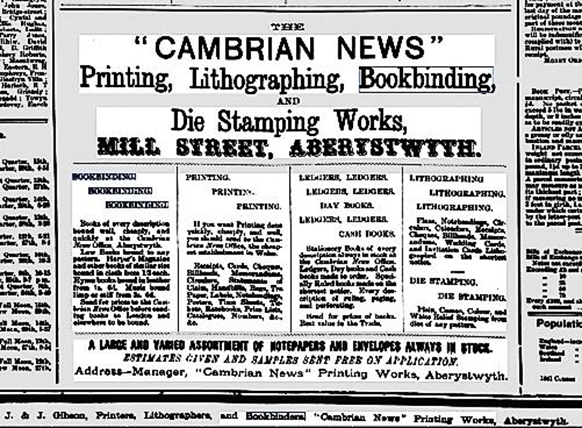
J. & J. Gibson, of The “Cambrian News” Printing Works in Aberystwyth, in December 1893, ran an extensive set of operations, which included Bookbinding.


Figure 3: Cambrian News, 1893


Circulating Libraries

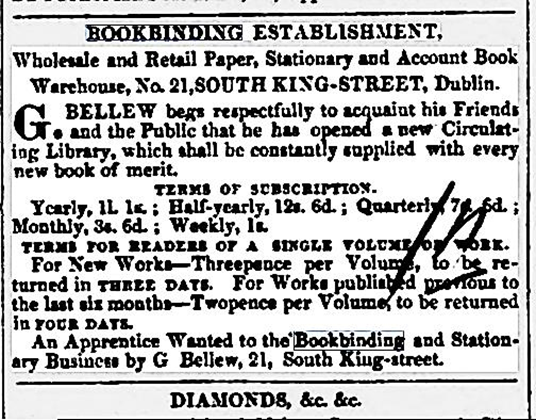
Bookbinders were conscious of the opportunities to acquire binding work from circulating libraries.  Some went one step further, organising their own. In Saunders’s Newsletter 18 February 1839 (page 3),  G. BELLEW advertised : ‘Bookbinding Establishment, Wholesale & Retail Paper, Stationery and Account Book Warehouse, No. 21 South King Street Dublin … begs respectfully to acquaint his Friends and the Public that he has opened a new Circulating Library, which will be constantly supplied with every new book of merit’.


Figure 4: Saunders’s Newsletter, 18 February 1839


In the 1780s and 1790s, one of the largest and most prestigious libraries in Bath was that of James MARSHALL - ‘Marshall’s Library (late Mr. Pratt), Top of Milsom-Street, Bath … offers the Nobility and Gentry a new and enlarged Catalogue of his Circulating Library…’ (Bath Chronicle 8 October 1787 page 1).


Journeymen Advertisements

The bookbinding trade needed new recruits, so advertisements were regularly placed for journeymen. A couple of advertisements appeared in the Leeds Mercury for 1807. One was placed by Edwards & Son, Halifax on the 2nd May 1807. C. Lawton, a Bookseller, in Otley had advertised for one on 24th January 1807. The Alnwick Mercury of 1st February 1855 advertised for a journeyman printer and a journeyman bookbinder, with applications being made to their Office.


Sales of bookbinding equipment by auction

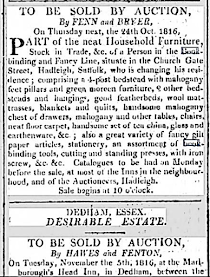
Bookbinders left their business, and sometimes they suffered misfortune such as bankruptcy. In 1816, a bookbinder was moving away from Hadleigh and selling his bookbinding tools, amongst other household goods. The advertisement appeared in the Suffolk Chronicle on 19 October (page 1): ‘To be sold at AUCTION. By Fenn and Bryer. Part of the …Stock in Trade of a person in the Bookbinding and Fancy Line…’


Figure 5: Suffolk Chronicle, 19 October 1816


E. [Edward?] Foden had been made bankrupt and Margetts & Son advertised the auction of his goods, including his bookbinding materials: ‘To Printers, Booksellers Stationers, Bookbinders and the Public in General. To be sold at Auction by Margetts & Son …on the Premises of Mr. E. Foden, Jury Street, Warwick, a Bankrupt…’ (Warwick and Warwickshire Advertiser 24 June 1826 page 2). 


Figure 6: Warwick and Warwickshire Advertiser, 24 June 1826


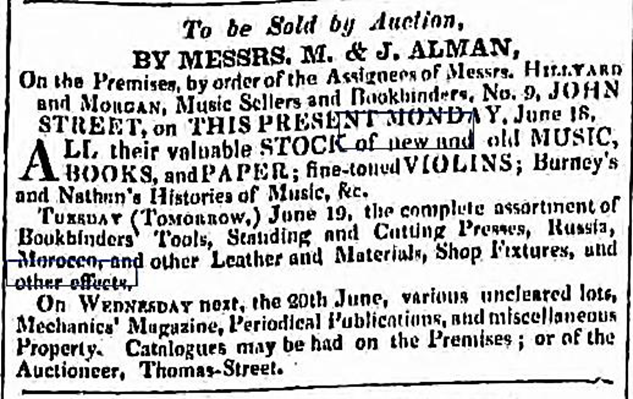
The auctioneers M. & J. Alman organised the sale in 18 June 1827 of the stock and bookbinders tools, etc., as a result of Messrs Hillyard and Morgan, Music Sellers and Bookbinders, possibly going out of business (Bristol Mercury 18 June 1827 page 2).


Figure 7: Bristol Mercury 18 June 1827


A.T. and E. Crow (auctioneers) advertised the sale of the effects of William SINCLAIR ‘... who is declining Business…’, authorised the sale of his Bookbinding Plant (Sunderland Daily Echo 27 November 1900 page 2).


Figure 8: Sunderland Daily Echo, 27 November 1900


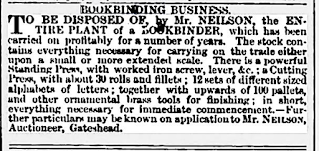
The stock of an unnamed bookbinder was to be sold by ‘Mr. NEILSON, Auctioneer, Gateshead. Bookbinding Business to be disposed of.’(Newcastle Daily Chronicle 1 August 1864 page 2).


Figure 9: Newcastle Daily Chronicle, 1 August 1864


Accidents

Bookbinders’ premises had machinery and flammable materials, so accidents did occur.

a)  A fire happened at the workshop of bookbinder John Berry ‘consuming two of his rooms’ before being brought under control (Carlisle Journal 6 November 1802 page 2).

b)  Bookbinder, John Dunn, caught his right hand in a pinching machine and lost two fingers as a result (Edinburgh Evening News 11 January 1898 page 2).

c)  On the 29 November 1860, a fire caused the ‘Destruction of Norman and Metcalf’s Bookbinding Establishment, Leigh Place, Brooke’s Market, Holborn.’ The cause was likely to have been arson (Morning Chronicle 30 November 1860 page 3).

d) A tragic accident involved a Mr. Stephenson, bookbinder, who was eating beef cakes in the Red Lion, Petty Curry, Cambridge, when a pin lodged in his windpipe. He died of asphyxiation (Norfolk Chronicle 22 September 1781 page 2).


Robberies

Book binders had enough equipment deemed valuable, so robberies were attempted.

a)  Under the headline: ‘Daring Robbery in St. John Street’, Frederick Pointon, book-binder, had been set upon, and robbed by Mary Jenkins and an accomplice of 5s 6d, of a corkscrew and bookbinders type. (Cheshire Observer 11 October 1856 page 6).

b)  In Carnarvon, Hugh Jones, a Bookbinder, was indicted for stealing three Welsh Bibles, and other books (North Wales Chronicle 20 March 1875 page 6).

c)  A bookbinder ‘on tramp’, Wm. SUMNERS, ‘…was charged with stealing a topcoat…’ (Stamford Mercury 1 February 1861 page 5).

d) A more serious offence was the accusation that Josiah Westley had forged two bills of exchange with intent to defraud Messrs. Glyn and Co. Bankers… (Westmorland Gazette 25 October 1851 page 8).


Figure 10: Westmorland Gazette 25 October 1851


Society for Promoting Christian Knowledge (SPCK)


The Society for Promoting Christian Knowledge provided much work for bookbinders, owing to the numbers of books sold by them.

a)  The Liverpool District Branch meeting of the Society reported to its annual meeting that it had sold: 963 Bibles, 906 testaments, 2,436 common prayer books, 1,352 bound books, 18,235 half-bound [books] and school books (Manchester Courier 19 January 1828 page 2).

b)  The Salisbury Annual Branch Meeting in early 1872 listed the books sold (in 1871): ‘Bibles, 546; ditto with Prayer, 16; Testaments, 134; Prayer Books, 1,813; Books bound and half-bound, 4,399; Tracts, 5,654; Apocrypha, 13; maps, 36; Church Services, 196, almanacks, 1,298; total, 14,105’ (Hampshire Advertiser 27 January 1872 page 7).

Clearly, dissemination by the SPCK of Bibles, prayer books and other publications was good business for bookbinders, and give us a glimpse of the large amount of work undertaken, year after year.


Figure 11: Manchester Courier 19 January 1828


Figure 12: Hampshire Advertiser 27 January 1872


Exhibitions

A series of lectures on bookbinding given at the Society of Arts in 1898, which were accompanied by an exhibition in the Library, of one hundred and thirty bindings, many of which were lent by private collectors (Morning Post 25 January 1898 page 3). The binding of the official catalogues of the Great Exhibition of 1851 elicited a long letter by John Wright, binder, of Soho, in which he complains of the lack of a fair competition to bid for the work to bind the catalogues (Morning Chronicle 5 January 1853 page 3).


Strikes / Loss of Trade

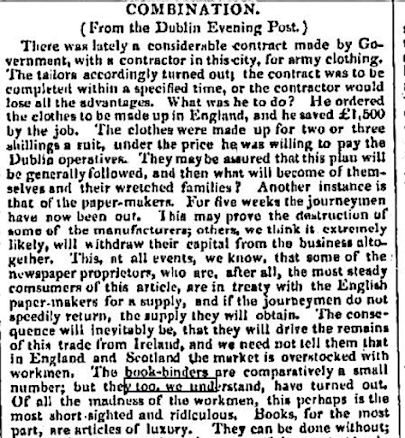
COMBINATION. A long article in 1826 drew attention to the recent difficulties encountered by several trades, resulting in strikes by workmen in Dublin, including bookbinders (Glasgow Herald 25 August 1826 page 1).

 Figure 13: Glasgow Herald 25 August 1826


Under a somewhat misleading heading ‘The Bookbinders’ Strike’, James Mahoney accused of intimidating Robert Steer (Bookbinder?), who refused to come out on strike with other men at the Armoury, Southwark (Reynolds’s Newspaper 20 March 1892 page 1).  


Bookbinders employed by Waterlow and Sons, and Shaw and Co., ‘…struck work on account of the refusal of the firms to grant an eight hours day…’, asking for other bookbinders in England to ‘block’ these two firms.  (Morning Post 17 November 1891 page 3).


Figure 14: Morning Post 17 November 1891


Miscellaneous articles


Sam. Campbell Bookbinder, attested to the efficacy of Spilsbury’s Antiscorbic Drops: ‘Sir, I had been grievously afflicted with a Scurvy in my Legs for several years, to such a degree as to render me some considerable time incapable to work at my Business of Book-binding…by Use of only a few bottles [of the remedy], through the blessing of God, am now perfectly whole.’  (Norfolk Chronicle 18 January 1783 page 4).


In 1858, we find Wm. Kilpatrick, stating that he was acting as an Agent for Virtue & Co. (Newcastle Daily Chronicle 4 August 1858 page 1).


Figure 15: Newcastle Daily Chronicle 4 August 1858


Bookbinding even received mentioned in a House of Commons debate, when Lord Russell, in a Resolution and Speech to the House of Commons, 25 April, 1822, alluded to the advancement of knowledge though the work of publishers, and one which: ‘… annually sold 5,000,000 of copies, employed sixty-two clerks; expended 5,000l. for advertisements; and gave employment to 250  bookbinders.’ (Glasgow Herald 29 April 1822 page 2).


The virtues of using caoutchouc as a means of binding leaves, were stated as early as 1837. In the article: ‘Improvement in Book-Binding’, Mr. Hancock, its inventor, claimed that the attachment of the leaves of a book using caoutchouc would dispense ‘…entirely with the process of sewing and of sawing.’ (Freeman’s Journal 6 September 1837 page 4).  


Figure 16: Freeman’s Journal 6 September 1837


Bookbinders were listed in the ‘marriage’ and ‘died’ notices in newspapers. Occasionally, small notices were printed, as was the obituary for Archibald Steele, ‘Death of an Old Edinburgh Book-binder’, who had worked for Oliver and Boyd in Edinburgh for fifty-three years. (Edinburgh Evening News 28 September 1901 page 4).


Figure 17: Edinburgh Evening News 28 September 1901


There was quite a lot of detail printed for the life of Edward John GRIFFIN: ‘Death in London of Mr. E. J. Griffin, …until a few years ago well-known in Warwick as a Bookbinder.’ (Warwick and Warwickshire Advertiser 11 March 1939 page 5).

 Figure 18:  Warwick and Warwickshire Advertiser 11 March 1939


These advertisements, notices and articles reinforce the reality of bookbinding being embedded in local life. With all this evidence, we are taken back into the circumstances of the day, in which all manner of trades operated, together with glimpses of how they lived and where they worked.


Appendix A:  Index of Bookbinders/ Notices/Articles


1)      John AISLEY Bookseller, Durham. ‘Books neatly Bound.’ Newcastle Courant 15 January 1743 page 3; 22 January 1743 page 4

2)      Robert AKENHEAD Bookseller, Newcastle. ‘Books Bound after the neatest and best Manner.’ Newcastle Courant 9 October 1742 page 3

3)      APPEAL OF THE JOURNEYMEN BOOKBINDERS [Praise for the S.P.C.K. paying more to its binders for the Pearl Bible, than other binders who bound for the British and Foreign Bible Society.] Exeter and Plymouth Gazette 15 September 1849 page 8

4)      An APPRENTICE is wanted to the Bookbinding Business. Saunders’s Newsletter 22 July 1777 page 3

5)      ARDEN PRESS LTD. [Move of companies to Letchworth Garden City.] ‘Messrs W. H. Smith and Son, of Strand, London who are removing their bookbinding business to the estate, Messrs. Dent and Co., Publisher, of Covent Garden, who are also transferring their bookbinding department here, and the Arden Press Ltd., Publishers and Bookbinders.’ Herts Advertiser 15 December 1906 page 8

6)      W. ATKINSON Machine Printing Establishment, Market Place, Penrith. ‘Printing, Engraving and Bookbinding.’ Penrith Observer 6 August 1861 page 8

7)      ATKINSON and POLLITT Kendal. ‘Bookbinding in cloth, Roan, Calf or Morocco… at reasonable prices.’ Westmorland Gazette 13 April 1889 page 7

8)      To be sold at AUCTION. By Fenn and Bryer. ‘Part of the …Stock in Trade of a person in the Bookbinding and Fancy Line…’ Suffolk Chronicle 19 October 1816 page 1

9)      John BAGNALL Printer, St. Nicholas Street. Ipswich Journal 18 April 1724 page 4 colophon ‘Books bound in Calf, Sheep, etc.’; 2 March 1734 page 4 Colophon: ‘And books neatly bound’

10)    George Thomas BAGGULEY Newcastle-under-Lyme ‘Bookbinder to three Queens’. Aberdeen Press and Journal 8 August 1950 page 3.

11)    William BANCKS Bookseller and Stationer, Mill Gate, Wigan. Manchester Mercury 12 June 1764 page 4

12)    Henry BAZLEY ‘Charge of Abduction against a Bookbinder. … Henry Bazley, a bookbinder of S. Bishop’s-court, Clerkenwell …charged…with having taken Elizabeth Morey, a girl under the age of eighteen, out of the possession of her mother.’ Reynolds’s Newspaper 24 September 1891 page 6

13)    G. BELLEW Bookbinding Establishment, Wholesale & Retail Paper, Stationery and Account Book Warehouse, No. 21 South King Street Dublin ‘… begs respectfully to acquaint his Friends and the Public that he has opened a new Circulating Library, which will be constantly supplied with every new book of merit’. Saunders’s Newsletter 18 February 1839 page 3

14)    John BERRY ‘…a fire broke out in the Workshop of Mr. John Berry, Bookbinder in Temple Lane, Liverpool…’ Carlisle Journal 6 November 1802 page 2

15)    J. BIGWOOD Bookbinder and Paperhanger &c. 4 Poplar Place, Thomas Street, Trowbridge. ‘…has re-commenced in Business… Books bound to Pattern.’ Wiltshire Times 1 August 1863 page 1

16)    Henry Hunter BLAIR Bookseller, Stationer, Printer, and Bookbinder, Books Bound. Alnwick Mercury 12 January 1884 page 4

17)    George BOGGAN Steam Printing, Bookbinding, Paper Ruling, and Stationery Works, 9 and 11 York Street, Sunderland. Sunderland Daily Echo 21 May 1878 page 1

18)    A NOBLE BOOKBINDER. Prince Aginski ‘has established in this City (Paris) a bookbinder’s work-shop’ Bradford Observer 16 November 1835 page 6

19)    BOOKBINDERS ‘Meeting of Bookbinders [of the City of Dublin].’ Freeman’s Journal 19 November 1830 page 4

20)    BOOKBINDING ‘Books Bound in Plain and Elegant Bindings, on reasonable Terms, at the Gazette Office, Market-Place, Lancaster.’ Lancaster Gazette 21 February 1857 page 7

21)    BOOKBINDING CLASSES ‘…first Report to the Council of the Consultative Committee on the Teaching of Bookbinding in London Technical Schools.’ Morning Post 22 June 1908 page 3

22)    BOOKBINDING EXHIBITION at the Society of Arts. Morning Post 25 January 1898 page 3

23)    BOOKBINDING FOR WOMEN. Penrith Observer 11 March 1902 page 6

24)    BOOKBINDING ‘Improvement in Book-Binding.’ Mr. Hancock’s invention of Caoutchouc. Freeman’s Journal 6 September 1837 page 4

25)    F. J. BROOKE ‘(late Fuller and Co.) Bookseller, Stationer, Printer, Bookbinder, and Fancy goods Factor, Broad Street, Worcester.’ Worcester Journal 23 June 1900 page 1

26)    Thomas BURROUGH Bookseller and Stationer, Devizes. ‘Books neatly Bound, Lett’rd and Gilt.’ Salisbury and Winchester Journal 20 January 1752 page 4

27)    CAMBRIAN NEWS OFFICE Bookbinding, ‘Periodicals of every description bound cheaply’. Cambrian News 12 June 1891 page 8

28)    Sam. CAMPBELL Bookbinder. Attested to the efficacy of Spilsbury’s Antiscorbic Drops. Norfolk Chronicle 18 January 1783 page 4

29)    CARNAN and SMART, Reading. Reading Mercury 24 November 1783 page 3; 29 December 1783 page 3

30)    CHAMBERLAIN’S Bookbinding! 29 High Street, Exeter. Exeter and Plymouth Gazette 27 June 1916 page 4

31)    J. CHEESEWRIGHT Book and Print Seller, Stationer, Printer and Bookbinder, No. 3, High Street, next the Castle Bank [Bristol].’ Advertises his ‘extensive library’ and ‘a spacious and comfortable reading room’. Bristol Mercury 10 January 1835 page 1

32)    W. V. COLE & SONS, 87 & 88 South Street, Exeter. Western Times 11 October 1940 page 2; 22 November 1940 page 2.

33)    COMBINATION [Strikes by Workmen in Dublin, including Bookbinders] Glasgow Herald 25 August 1826 page 1

34)    David CONDIE ‘Bookbinding and Stationery, Black Friars, Broad Street, Worcester.’ Worcester Journal 9 August 1849 page 2

35)    A. K. COWELL Printing, Bookselling, Bookbinding, Butter-market, Ipswich. ‘Mr. R. N. Rose, finding it necessary to dispose of his Business, A. K. Cowell has been induced to take it…’ Suffolk Chronicle, 25 July 1818 page 2

36)    DARING ROBBERY IN ST. JOHN STREET [CHESTER]. Frederick Pointon, book-binder, robbed by Mary Jenkins of 5s 6d, a corkscrew and bookbinders type. Cheshire Observer 11 October 1856 page 6

37)    DEIGHTON & CO. ‘…every description of bookbinding…is done on the premises, at 53 High-Street, Worcester.’ Worcestershire Chronicle 18 January 1875 page 5; 25 January 1879 page 1; 1 February 1879 page 1; 8 February 1879 page 123 March 1879 page 4

38)    H. DEIGHTON Bookseller. ‘Books Bound.’ 19, Pavement, York. York Herald 8 December 1827 page 2

39)    DENT AND CO. [Move of companies to Letchworth Garden City.] ‘Messrs W. H. Smith and Son, of Strand, London who are removing their bookbinding business to the estate, Messrs. Dent and Co., Publisher, of Covent Garden, who are also transferring their bookbinding department here, and the Arden Press Ltd., Publishers and Bookbinders.’ Herts Advertiser 15 December 1906 page 8

40)    John Kenmuir DOUGLAS ‘The “North Wales Chronicle” Steam Printing and Stationery Establishment. Lithographic, Copper-Plate, and Letterpress Printer, Stationer and Bookbinder, High Street, Bangor.’ North Wales Chronicle 2 November 1867 page 1

41)    JAMES DUFFY & CO. 'Prayer Books printed and Bound in our own Factory.' 38 Westmoreland Street, Dublin. Freeman’s Journal 11 December 1907 page 6

42)    T. DUNN Bookseller, Binder, and Stationer, the Corner of College Court in the Westgate Street. Oxford Journal 4 December 1779 page 3.

43)    R. EAGLE & CO. Wholesale Stationers, General Printers and Bookbinders, Engravers and Pattern Case Makers, 15, Church Bank Bradford. Bradford Observer 12 October 1876 page 1

44)    James FLEMING Bookseller, Books Bound, Tyne-bridge Newcastle. Newcastle Courant 5 August 1738 page 4; 14 January 1749 page 3; 14 & 21 October 1749 page 3

45)    [Edward] FODEN ‘To Printers, Booksellers Stationers, Bookbinders and The
Public in General. To be sold at Auction by Margetts & Son …on the Premises of Mr. E. Foden, Jury Street, Warwick, a Bankrupt…’ Warwick and Warwickshire Advertiser 24 June 1826 page 2

46)    W. FRANKLIN Neville Street (opposite the Central Station) [Newcastle] Books Bound. Newcastle Daily Chronicle 24 June 1865 page 1; 21 August 1865; 30 August 1865

47)    FREE EMIGRATION TO QUEENSLAND [for] BOOKBINDERS. Kendal Mercury 30 September 1876 page 7 

48)    GENEROUS GIFT TO ST. MARY’S CHURCH [Bury St. Edmunds] '... of Prayer Books and Hymn Books which are bound in whole calf, black with gilt lettering and edgings.' Bury and Norwich Post 10 April 1900 page 5

49)    GILBERT & M’DONALD Rose Street, North Lane, ‘Accident in Edinburgh Bookbinders’. Edinburgh Evening News 7 December 1904 page 4

50)    J. & J. GIBSON The “Cambrian News” Printing, Lithographing, Bookbinding, and Die Stamping Works, Mill Street, Aberystwyth. Cambrian News 29 December 1893 page 9

51)    JOSEPH GLEAVE & SONS New Printing Office and Stationery Warehouse, opposite the Royal Hotel, top of Market-street. Manchester Courier 31 March 1827 page 2

52)    William GRAY Bookbinder ‘…is selling copies of “Faith and Fancy”’ Caledonian Mercury 19 August 1745 page 8

53)    J. H. GREAVES Printer, Bookseller, Stationer, Music Seller, Books Bound, 36, Snig Hill, Sheffield. Sheffield Independent 18 December 1845 page 1

54)    Edward John GRIFFIN ‘Death in London of Mr. E. J. Griffin, …until a few years ago well-known in Warwick as a Bookbinder.’ Warwick and Warwickshire Advertiser 11 March 1939 page 5

55)    J. & W. GRIFFIN ‘Bookbinding to any pattern at the lowest possible prices. “Observer” Office, The Bridge, Walsall. Walsall Observer and South Staffordshire Chronicle 19 August 1882 page 2; 11 November 1882 page 2; 10 May 1884 page 2; 3 January 1885 page 3

56)    George HARRISON Stationery Warehouse & Account Book Manufactory, 51 High Street Belfast.  Belfast Newsletter 1 June 1830 page 2;

57)    John HARRISON Bookseller ‘A catalogue of Curious Books…’ Newcastle Courant 15 January 1743 page 3

58)    A. HART Bookbinder, 49 Coggeshall-road, Braintree. Estimates Given. Essex Herald 20 January 1890 page 4; 4 February 1890 page 4; 24 February 1890 page 4; 17 March 1890 page 1; 5 April 1890 page 1; 3 May 1890 page 1

59)    W. C. HAYES Printer & Stationer, Chipping Norton. Books Bound. Oxford Journal 20 February 1909 page 1

60)    W. F. HEALEY & CO. General Printers, Manufacturing Stationers and Bookbinders, Bridge-street Row, Chester. Wrexham Advertiser 10 November 1860 page 1

61)    William HENLEY Bookseller, Stationer, Printer, Bookbinder. Gloucester Journal 8 January 1887 page 1

62)    Frank H. HILLS Printer, Stationer, Bookseller, Bookbinder and Newsagent, Post Office, Sevenoaks.  Kent & Sussex Courier 19 October 1877 page 8

63)    HILLYARD and MORGAN ‘To be sold by Auction by Messrs. M. & J. Alman, on the Premises, by order of the Assignees of Messrs. Hillyard and Morgan, Music Sellers and Bookbinders, No. 9, St. John Street [Bristol]’. Bristol Mercury 18 June 1827 page 2

64)    HODGE’S Bookbinding and Stationery, 56, High Street, Exeter. Books Bound. Western Times 15 December 1855 page 4; 29 December 1855 page 4; 20 January 1856 page 4; 23 February 1856 page 4

65)    HUMAN SKIN FOR BOOKBINDING. Exeter and Plymouth Gazette 9 September 1902 page 3

66)    Hugh JONES Bookbinder. ‘Charge against Carnarvon Tradesman…Hugh Jones, Bookbinder, was indicted for stealing three Welsh Bibles…’ North Wales Chronicle 20 March 1875 page 6

67)    JOURNEYMAN, Advertisement for; placed by Edwards & Son, Halifax. Leeds Mercury 2 May 1807 page 3

68)    JOURNEYMAN, Advertisement for; placed by C. Lawton, Bookseller, Otley. Leeds Mercury 24 January 1807 page 3

69)    JOURNEYMAN BINDER, Advertisement for, ‘Application to be made at the Mercury Office No. 22 Bondgate Street Within, Alnwick.’ Alnwick Mercury 1 February 1855 page 15

70)    JOURNEYMEN BOOKBINDERS ‘Third Appeal of the Journeymen Bookbinders of London. To their Brethren of all Trades in all parts of the United Kingdom.’ The Odd Fellow 29 June 1839 page 4

71)    JUBY Bookbinder, St. Margaret’s Green, Ipswich. Ipswich Journal 17 March 1900 page 4

72)    John KENDALL Jun. and Thomas KENDALL Bookbinders, Booksellers, and Stationers, near the Red Lion Inn, in Colchester. Ipswich Journal 6 May 1749 page 4

73)    Benjamin KEITHLEY, Bookbinder, in Coghill’s-court, Daine-street, ‘Lodgings to be let for the Summer Season, County Wicklow. For further Particulars, inquire of …’. Saunders’s Newsletter 7 July 1777 page 3

74)    Wm. KILPATRICK Agent for Virtue & Co. Newcastle Daily Chronicle 4 August 1858 page 1.

75)    William KNIGHT and KING Printers, Booksellers, Stationers, and Bookbinders, Higham ‘… having dissolved their partnership…’ Essex Herald 26 August 1845 page 1

76)    Benjamin LANSDOWN’S General Printing & Bookbinding Establishment, Silver Street, Trowbridge. ‘Bookbinding in all its Branches…’ Wiltshire Times 8 August 1863 page 8

77)    LEATHER BOUND BOOKS [Treatment of] Birmingham Daily Gazette 3 April 1908 page 2.

78)    Joseph LEE Bookseller and Stationer, in High Street (next door to the White-Lyon), Ipswich. ‘Libraries gilt and letter’d. at reasonable prices, at Gentlemen’s own Houses.’  Ipswich Journal 4 & 11 & 18 February 1749 page 4

79)    William LEICESTER Bookseller, Stationer, Bookbinder ‘has opened a Shop adjoining Eastgate, Chester’. Chester Chronicle 17 July 1789 page 3

80)    John LINN Bookbinder, at Locke’s Head upon the Middle of the Tyne-Bridge, Newcastle.  Newcastle Courant 29 July 1738 page 3 and 5 August 1738 page 4 ‘He purchases Gentlemen’s Libraries or any Parcel of old books’

81)    T. W. MADDOX Bookseller, Stationer, Printer, and Bookbinder, South-Gate, Launceston. Royal Cornwall Gazette 29 September 1843 page 3

82)    J. [James] MARSHALL ‘Marshall’s Library (late Mr.[Samuel Jackson] Pratt), Top of Milsom-Street, Bath … offers the Nobility and Gentry a new and enlarged Catalogue of his Circulating Library…’ Bath Chronicle 8 October 1787 page 1

83)    S. G. MASON (Chester) LTD. Printing and Bookbinding, 10 St. John Street, Chester. Cheshire Observer 3 January 1969 page 16

84)    MASSEY & CO. Printers and Bookbinders. ‘For First Class Bookbinding.’ Castle St. Trowbridge. Wiltshire Times 9 October 1948 page 5

85)    MATTHIAS’S Bookbinding, 22, Gloucester Street, Gloucester. Gloucester Journal 8 January 1887 page 1

86)    George MATTON Stationer, Bookbinder, Machine Ruler, and Book & Pager, 6 and 7 Greenwood-street, Corporation-street. Manchester Courier 22 July 1854 page 2

87)    Edwin MORAN Bookbinder, 28 Villiers Street. ‘Books Bound with Elegance and Durability.’ Sunderland Daily Echo 20 January 1875 page 1

88)    James Fitzgerald MURPHY ‘A middle-aged journeyman bookbinder’, received a legacy of £10,000 from an uncle in New South Wales. Worcestershire Chronicle 20 July 1891

89)    Mr. NEILSON, Auctioneer, Gateshead. Bookbinding Business to be disposed of. Newcastle Daily Chronicle 1 August 1864 page 2

90)    NORMAN and METCALF ‘Destruction of Norman and Metcalf’s Bookbinding Establishment, Leigh Place, Brooke’s Market, Holborn.’ [George James Norman and Frederick Eardey Medcalf – Packer.] Morning Chronicle 30 November 1860 page 3

91)    CITY OF NOTTINGHAM Public Libraries - Bookbinding, ‘Tenders are invited for the Re-Binding of Books.’ Nottingham Journal 4 March 1939 page 2

92)    OLIVER & BOYD [Bookbinders] Edinburgh Evening News 28 September 1901 page 4

93)    John PAAS ‘Horrible Murder at Leicester, of Mr. Paas of London.’ Paas murdered by James Cook, Bookbinder. Preston Chronicle 9 June 1832 page 4

94)    PHILLIPS Bookbinding Friar Street, Ipswich. Ipswich Journal 17 March 1900 page 4

95)    J. POOLE Bookseller, Books Bound ‘as neat as in London’, Eastgate Street, Chester. Chester Chronicle 4 September 1775 page 1

96)    PUNCHARD & JERMYN Booksellers, Ipswich. Bury and Norwich Post 11 July 1787 page 3.

97)    Thomas ROBERTS ‘Lithographic Printing, Engraving, Bookbinding, and General Stationery Office. Bookbinding in all its branches.’ Wrexham Advertiser 15 April 1865 page 4

98)    LORD RUSSELL – Resolution and Speech to the House of Commons, 25 April, 1822. Glasgow Herald 29 April 1822 page 2

99)    UNFORESEEN RESULTS ‘Unforeseen Results.’ [Bookbinders were being made  unemployed as a result of revisions to the text of Bibles and Prayer Books by the Ritual Commissioners, which meant that no one wanted to order bound copies of the existing texts, preferring to wait for the new.] Herts Advertiser 26 March 1870 page 3

100)  THE WALTER SCOTT PUBLISHING CO. LTD. Printing, Bookbinding and Stationery. Felling-on-Tyne. ‘The best, cheapest and quickest work executed…’  Carlisle Journal 13 December 1912 page 4

101)  SILVER BOOK OF THE GOSPELS, Finishing of. ‘The Silver book of the Gospels.’ [How the bookbinder finishes the lettering in silver.] The Odd Fellow 26 February 1842 page 4

102)  William SINCLAIR ‘... who is declining Business…’, authorised the sale of his Bookbinding Plant. Sunderland Daily Echo 27 November 1900 page 2

103)  William SMART Bookseller, Stationer, and Binder has opened a genteel Shop, adjoining to the Town Hall in Worcester. Jackson’s Oxford Journal 6 August 1774 page 1; 20 August 1774 page 2; 3September 1774 page 1; 10 September 1774 page 1

104)  J. SMITH Bookbinding. Greenhow Factory, No. 8, Greenhow Yard, Highgate, Kendal. Kendal Mercury 28 January 1871 page 2

105)  Mr. SMITH  Bookbinder at the corner of Blackmore Street, committed suicide. Caledonian Mercury 24 April 1732 page 1

106)  W. H. SMITH AND SON [Move of companies to Letchworth Garden City.] ‘Messrs W. H. Smith and Son, of Strand, London who are removing their bookbinding business to the estate, Messrs. Dent and Co., Publisher, of Covent Garden, who are also transferring their bookbinding department here, and the Arden Press Ltd., Publishers and Bookbinders.’ Herts Advertiser 15 December 1906 page 8

107)  W. H. SMITH & CO. Newsagents Booksellers Bookbinders, 15 High Street, Tunbridge Wells. Kent and Sussex Courier 28 April 1933 page 6

108)  W. H. SMITH & CO. [Stand at Exhibition]. London Evening Standard 3 March 1908 page 10

109)  SMITHS Bookbinding, Suitall, Ipswich. Ipswich Journal 17 March 1900 page 4

110)  SOCIETY FOR THE PROMOTION OF CHRISTIAN KNOWLEDGE. Liverpool District Branch Meeting. [List of Books Sold] Manchester Courier 19 January 1828 page 2

111)  SOCIETY FOR THE PROMOTION OF CHRISTIAN KNOWLEDGE. Salisbury Annual Branch Meeting. Hampshire Advertiser 27 January 1872 page 7

112)  Archibald STEELE ‘Death of an old Edinburgh Bookbinder’. Edinburgh Evening News 28 September 1901 page 4

113)  Robert STEER ‘The Bookbinders’ Strike.’ James Mahoney accused of intimidating Robert Steer (Bookbinder?), who refused to come out on strike. Reynolds’s Newspaper 20 March 1892 page 1

114)  Mr STEPHENSON, Bookbinder. [He was eating beef cakes in the Red Lion, Petty Curry, Cambridge, when a pin lodged in his windpipe. He died of asphyxiation.] Norfolk Chronicle 22 September 1781 page 2).

115)  STRIKE OF BOOKBINDERS Morning Post 17 November 1891 page 3

116)  STOCK OF BOOKBINDING MATERIALS ‘…to be disposed of [by] J. Gaythorp, Bookseller. Carlisle Journal 7 February 1851 page 1

117)  Wm. SUMNERS ‘…a bookbinder on tramp, was charged with stealing a topcoat…’ Stamford Mercury 1 February 1861 page 5

118)  Francis THOMAS Bookbinder, 15, Boscawen Street, Truro. Royal Cornwall Gazette 27 December 1817 page 1

119)  C. & W. THOMPSON Booksellers, Stationers, Pattern-Card Manufacturers, Dealers in Genuine Patent Medicines, Printing Neatly & Expeditiously Executed, Books Bound, No. 1 Market Place, & 54 Westbar, Sheffield. Sheffield Independent 20 May 1820 page 1

120)  F. THOMPSON Bookseller, Stationer, Printer, Bookbinder, News Agent, and Dealer in English and Foreign Fancy Goods,  24, High Street, Bedford. Bedfordshire Times and Independent 2 August 1870 page 1; 6 August 1870 page 1; 30 August 1870 page 1

121)  Will. THOMPSON & Thos. BAILY Printers, Stamford. ‘Also Books neatly Bound…’ Stamford Mercury 19 August 1725 page 1; 7 November 1731 page 1

122)  C. F. TIMEAUS Printer, Stationer, Bookseller, Bookbinder, Die Sinker & Engraver, 90, High Street Bedford. Bedfordshire Times and Independent 12 November 1887 page 4; 19 November 1887 page 4; 3 December 1887 page 6; 10 December 1887 page 8; 7 January 1888 page 5

123)  [Mr.] TOMES ‘The new fashionable “Society” style of Bookbinding… is now binding books of the ordinary novel size…’ 43 and 45 Bedford Street, Leamington. Warwick and Warwickshire Advertiser 24 July 1886 page 2

124)  Thomas TROUD General Printing-Office. Superior and Fashionable Bookbinding, Fore-Street, Taunton. Dorset County Chronicle 18 June 1829 page 1

125)  F. W. WARD Bookbinding, 3, Watergate Row, Chester. Cheshire Observer 10 January 1925 page 1

126)  Mr. WATSON, Carver & Bookbinder, of Boston [married] to Miss Sophia Crosby, Milliner, of this place. Stamford Mercury 12 December 1817 page 3

127)  WEST MIDLANDS PRESS LIMITED ‘Capacity always available for Bookbinding.’ The Old Square, Walsall. Walsall Observer and South Staffordshire Chronicle 11 April 1963 page 12

128)  Josiah WESTLEY ‘…of Blackfriars, Bookbinder, was last week committed at Mansion House police-office, upon charges of having forged two bills of exchange…with intent to defraud Messrs. Glyn and Co. Bankers… Westmorland Gazette 25 October 1851 page 8

129)  Mr. WHEELER Bookbinding, 20 & 21 St. Mary-Street, Weymouth. Dorset County Chronicle 8 April 1880 page 20

130)  C. W. WHITEHEAD Christmas Greeting Cards. Printer, Stationer, and Bookbinder, Shop: 125, Fishergate Preston. Preston Chronicle 29 November 1890 page 1

131)  P. WILCOX, Stationer & Bookbinder, 12, Bell-Street, Canal Terrace, Southampton. Hampshire Advertiser 28 June 1828 page 1

132)  Joseph WILKINSON Stationer, Bookbinder, and Genuine Patent Medicine Vendor, Pudding-Lane, Lancaster. Lancaster Gazette 30 November 1811 page 1

133)  Robert WILSON & SON Booksellers, Bookbinders, and Stationers, 1, St. Nicholas Street, Aberdeen. Aberdeen Press and Journal 24 December 1862 page 4

134)  WOMEN BOOKBINDERS ‘…a scale of rates for women has been agreed…’ Nottingham Journal 29 October 1915 page 6

135)  C. WRIGHT Bookseller, Stationer, Bookbinder, Bridlesmith Gate, Nottingham, opened a shop and ‘a small select circulating library will speedily be established.’  Nottingham Journal 19 December 1812 page 3

136)  J. WRIGHT Bookseller, Binder and Stationer, Account Book Manufactory No. 6 King Street, Manchester. Manchester Courier 31 March 1827 page 2

137)  John WRIGHT [Letter to the Editor about] ‘The Binding of the Catalogue of the Great Exhibition.’ Signed: ‘JNO. WRIGHT, 14 & 15 Noel-Street, Soho.’ Morning Chronicle 5 January 1853 page 3


APPENDIX B:  List of Newspaper Titles consulted


Aberdeen Press and Journal

Alnwick Mercury

Bath Chronicle

Bedfordshire Times

Belfast Newsletter

Birmingham Daily Gazette

Bradford Observer

Bristol Mercury

Bury and Norwich Post

Caledonian Mercury

Carlisle Journal

Cambrian News

Cheshire Observer

Chester Chronicle

Dorset County Chronicle

Edinburgh Evening News

Exeter and Plymouth Gazette

Essex Herald

Freeman’s Journal

Glasgow Herald

Gloucester Herald

Gloucester Journal

Hampshire Advertiser

Herts Advertiser

Ipswich Journal

Kendal Mercury

Kent and Sussex Courier

Leeds Mercury

Manchester Courier

Manchester Mercury

Morning Chronicle (London)


Morning Post (London)

Lancaster Gazetteer

London Evening Standard

Newcastle Courant

Newcastle Daily chronicle

Norfolk chronicle

North Wales Chronicle

Nottingham Journal

Oddfellow

Oxford Journal

Penrith Observer

Preston Chronicle

Reading Mercury

Reynolds’s Newspaper

Royal Cornwall Gazette

Salisbury and Winchester Journal

Saunders’s Newsletter

Sheffield Independent

Stamford Mercury

Suffolk Chronicle

Sunderland Daily Echo

Walsall Observer

Warwick & Warwickshire Advertiser

Western Times

Westmorland Gazette

Wiltshire Times and Trowbridge Advertiser

Worcester Journal

Worcestershire Chronicle

Wrexham Advertiser

York Herald

­­­­­­­­­­­­­­­­­­­­­­­­

 Edmund M. B. King 

 St. Albans

2022


 Note: All images are © British Library Board; and texts within images are © British Newspapers Archive. The text of this essay is © Edmund M. B. King.